Three AI Warning Letters, Zero Policy Changes: Why Engineering Teams Can't Wait for Regulation
Tanny Kang
July 14, 2026
Last updated: July 14, 2026
Direct Answer
Has any major AI warning letter led to binding regulation? No. Three major letters since 2023 have asked governments to regulate AI so that it benefits human society rather than displacing workers and concentrating wealth. None produced a binding law. As of July 2026, AI regulation for businesses is a patchwork that covers narrow harms and says nothing about the letters' core concern: whether AI complements people or replaces them, and who shares in the gains. Those choices are being made by default inside companies right now. If you lead an engineering org, you are making them whether you intend to or not.
Overview
- What the new "We Must Act Now" statement says and who signed it
- A scorecard of the three previous AI warning letters and their outcomes
- What AI regulation for businesses actually exists in 2026, and what it ignores
- Why open letters don't become laws (the Signature-to-Statute Gap)
- What NOT to do while regulation stalls
- A responsible AI framework: 5 ways engineering leaders can act now
- FAQ
Another Week, Another Letter
On July 13, 2026, more than 200 economists and AI researchers, including 16 Nobel laureates and executives from Anthropic, OpenAI, and Google, published "We Must Act Now: A Statement on AI's Transformation of the Economy", organized by Stanford's Digital Economy Lab. The statement is four sentences long. Its core claim: AI could drive an economic transformation "larger than the Industrial Revolution, but unfolding over a vastly shorter time frame."
The ask is not about model safety or misuse. It is about who benefits. The signatories want institutions and incentives built so that AI "complements humans and benefits society": so that the productivity gains don't arrive as mass job displacement and concentrated wealth. As organizer Erik Brynjolfsson put it, the goal is to "generate prosperity for the many, not just the few."
It is a serious document signed by serious people. It is also the fourth major AI warning letter in 40 months. Before assuming this one changes anything, it's worth scoring the previous three.
The Scorecard: Three Letters, Three Asks, Zero Statutes
Three major AI warning letters issued between March 2023 and October 2025 called on governments to steer AI development toward societal benefit. None resulted in binding US regulation, and AI development and deployment continued uninterrupted through all three.
The pattern holds even for policies that briefly appeared to be wins. The Biden administration's Executive Order 14110 on AI (October 2023) was rescinded in January 2025. California's SB 1047, the closest any US bill came to the letter's asks, was vetoed in September 2024. The EU AI Act did pass, but it was proposed in April 2021, two years before the first letter; the letters can't claim it.
What AI Regulation for Businesses Actually Exists in 2026
If you strip out the announcements and count only binding rules, AI regulation for businesses in the US currently amounts to:
- One AI-specific federal law: the TAKE IT DOWN Act, covering non-consensual AI-generated intimate imagery.
- A state-by-state patchwork: state AI laws began taking effect in January 2026, with more arriving throughout the year. Most target narrow, specific harms: AI in hiring and employment decisions, deepfakes, automated decision disclosures. White & Case's AI regulatory tracker maintains a current list.
- A non-binding federal framework: the White House's March 2026 National Policy Framework for AI urges Congress to replace the patchwork of state laws with a uniform federal approach. It creates no compliance obligations. Congress has twice rejected proposals to preempt state AI laws.
- The EU AI Act, if you operate in or sell into the EU. It regulates AI by risk category, with obligations phasing in through 2027.
Notice what's missing. Nothing in that list addresses what the economists are actually warning about. No rule shapes whether companies deploy AI to augment their workforce or replace it. No rule addresses displacement, retraining, or the distribution of productivity gains. The letters keep asking for exactly that kind of steering, and it keeps not arriving. Which means the steering the letters call for is happening anyway, one company at a time, as a byproduct of ordinary adoption decisions that no one treats as consequential.
The Signature-to-Statute Gap
The Signature-to-Statute Gap: the distance between how quickly experts can agree that something is urgent and how slowly (if ever) that agreement becomes binding law. For AI, the gap is currently 40 months and counting.
The gap isn't a failure of sincerity. It's structural, and engineers will recognize the failure mode:
Letters are alerts, not runbooks. Each letter fires a high-severity alert ("this is urgent") but none ships the remediation. "Steer AI to benefit society" has no enforcement mechanism and no owner. The new economists' statement is explicit that it doesn't prescribe policy. An alert with no runbook and no owner gets acknowledged and dropped. Every on-call engineer has watched this happen to a Slack channel full of unactioned warnings.
The feedback loop is too slow. Legislative cycles run in years; AI capability cycles run in months. By the time a bill drafted around GPT-4-era concerns reaches a vote, the technology it regulates has shipped three generations. Lawmakers know this, which makes them hesitant to bind themselves to specifics. The result is frameworks and hearings instead of statutes.
The signatories disagree on the fix. The letters' signatories include people who want development slowed and people running the labs doing the developing. They can agree on a one-sentence warning precisely because it commits no one to anything specific. The moment a concrete bill (SB 1047) appears, the coalition splits, and the bill dies.
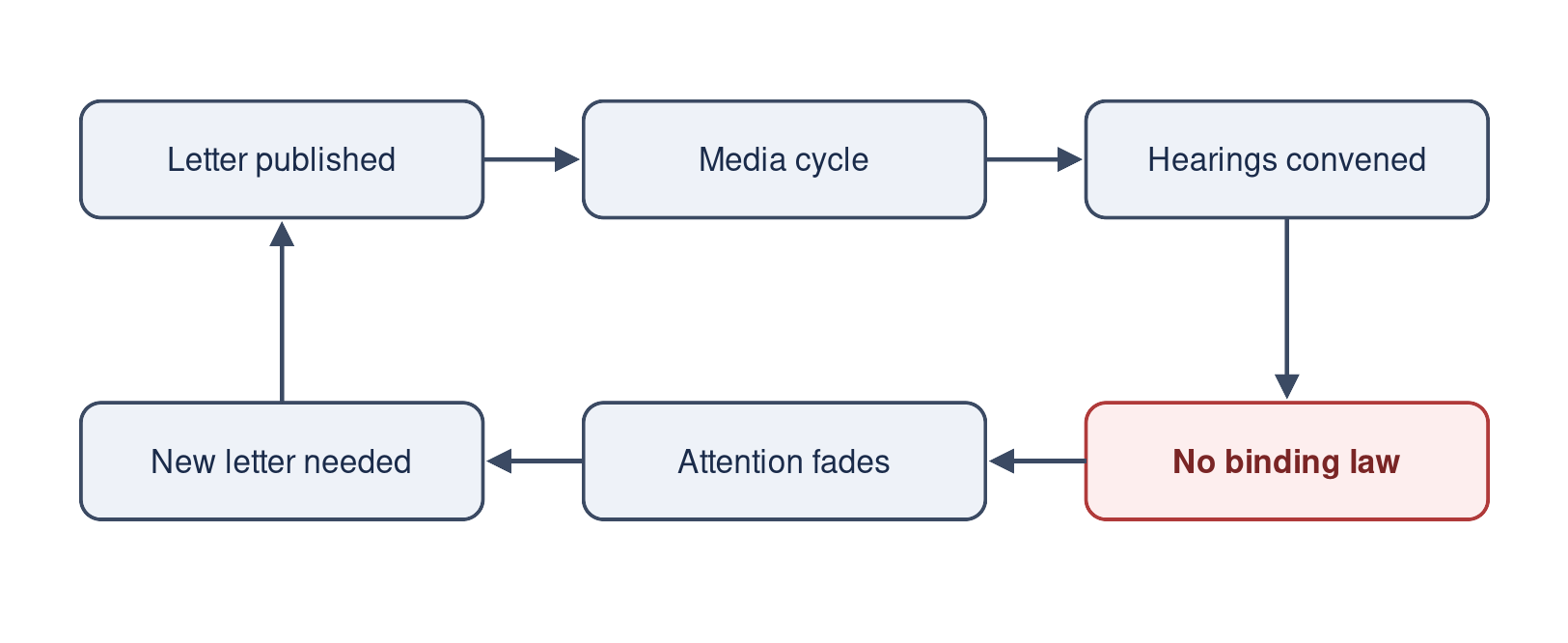
The open-letter cycle: each warning letter generates attention and hearings, but no binding law, and the unresolved urgency eventually produces the next letter.
What NOT to Do While Regulation Stalls
- Don't treat AI adoption as a pure headcount play. The scenario the economists warn about is not one dramatic policy failure. It is thousands of companies independently choosing replacement over augmentation because it's the easiest ROI story to tell. Cutting a team and backfilling with an unsupervised model is a choice, not an inevitability, and it compounds across the economy.
- Don't wait for regulation to define responsible AI use for your org. Congress has twice declined to set uniform rules. If your working definition of "responsible" is "whatever is legal," your definition is currently "almost anything."
- Don't let automation decisions happen bottom-up with no owner. When no one owns the question, individual teams automate whatever is easiest, and the org's answer to "what is AI for here?" becomes an accident of a hundred local decisions.
- Don't write AI principles without operational hooks. A values statement that never touches a hiring plan, a promotion path, or a tooling decision is the governance equivalent of a runbook nobody has ever executed.
Responsible AI Framework: 5 Ways Engineering Leaders Can Act Now
The letters ask governments to decide how AI's gains get distributed. Governments aren't deciding. Inside a company, the same choices exist at smaller scale, and engineering leaders are the ones making them.
1. Decide explicitly what AI is for in your org
Write down which work you intend AI to augment and which you intend it to automate, and who owns that decision. "AI complements humans" is the letters' language; the company-scale version is a named leader accountable for where the line sits, reviewed as capabilities change, instead of a default that emerges from whatever individual teams automate first.
2. Protect the junior pipeline on purpose
AI absorbs entry-level engineering work first, which quietly removes the work juniors learn on. If your org stops hiring or developing juniors because AI does their old tasks, you've traded a short-term saving for a seniority cliff in three years. Decide how people become senior in an AI-heavy workflow; don't let the ladder disappear by default.
3. Fund reskilling with time, not just licenses
Buying AI tool seats is not a reskilling program. Engineers need sanctioned time to rebuild their workflows around AI, and the incentive to do so: if using AI well doesn't show up in performance and promotion criteria, most people rationally won't invest. [Internal link: our AI-native engineering team playbook.]
4. Measure the human impact alongside the productivity gain
If AI adoption doubles your team's velocity while on-call load, after-hours pages, and attrition quietly climb, the gains are being captured somewhere other than your people. Track toil, workload distribution, and retention alongside velocity metrics, and treat divergence between them as a signal, not noise.
5. Treat the economists' timeline as capacity planning
The one actionable claim in the July 2026 statement: past transformations gave societies decades to adapt, and AI may give years. Stress-test your hiring plans, team structures, and skill assumptions against a world where AI capabilities double again in the next 18 to 24 months. Organizations that have thought about this in advance will make better choices under pressure than those that are improvising mid-transformation.
FAQ
Has any AI open letter led to actual regulation?
No major AI warning letter has directly produced a binding US federal regulation. The March 2023 pause letter, May 2023 risk statement, and October 2025 superintelligence statement generated hearings, summits, and executive actions, but the one relevant executive order was later rescinded, and no comprehensive federal AI statute exists as of July 2026.
What AI regulation applies to businesses in 2026?
US businesses face a patchwork: one narrow federal law (the TAKE IT DOWN Act), a growing set of state AI laws taking effect through 2026, and, for companies operating in Europe, the EU AI Act, whose obligations phase in through 2027. None of these addresses AI-driven job displacement or how productivity gains are shared.
Should companies wait for AI regulation before deciding how to use AI?
No. Congress has twice rejected federal preemption of state AI laws, and the White House's 2026 framework is non-binding, so no uniform rules are arriving soon. The decisions the warning letters want made (augment or replace, who benefits) are already being made implicitly through everyday adoption choices; the only question is whether a company makes them deliberately.
What does the "We Must Act Now" statement actually say?
The July 2026 statement, signed by 200+ economists and 16 Nobel laureates, warns that AI could transform the economy more than the Industrial Revolution did, but over a much shorter time frame, bringing both large-scale job-displacement risks and living-standard gains. It calls for building research, incentives, and institutions that steer AI to complement humans and benefit society, but it deliberately prescribes no specific policy.